
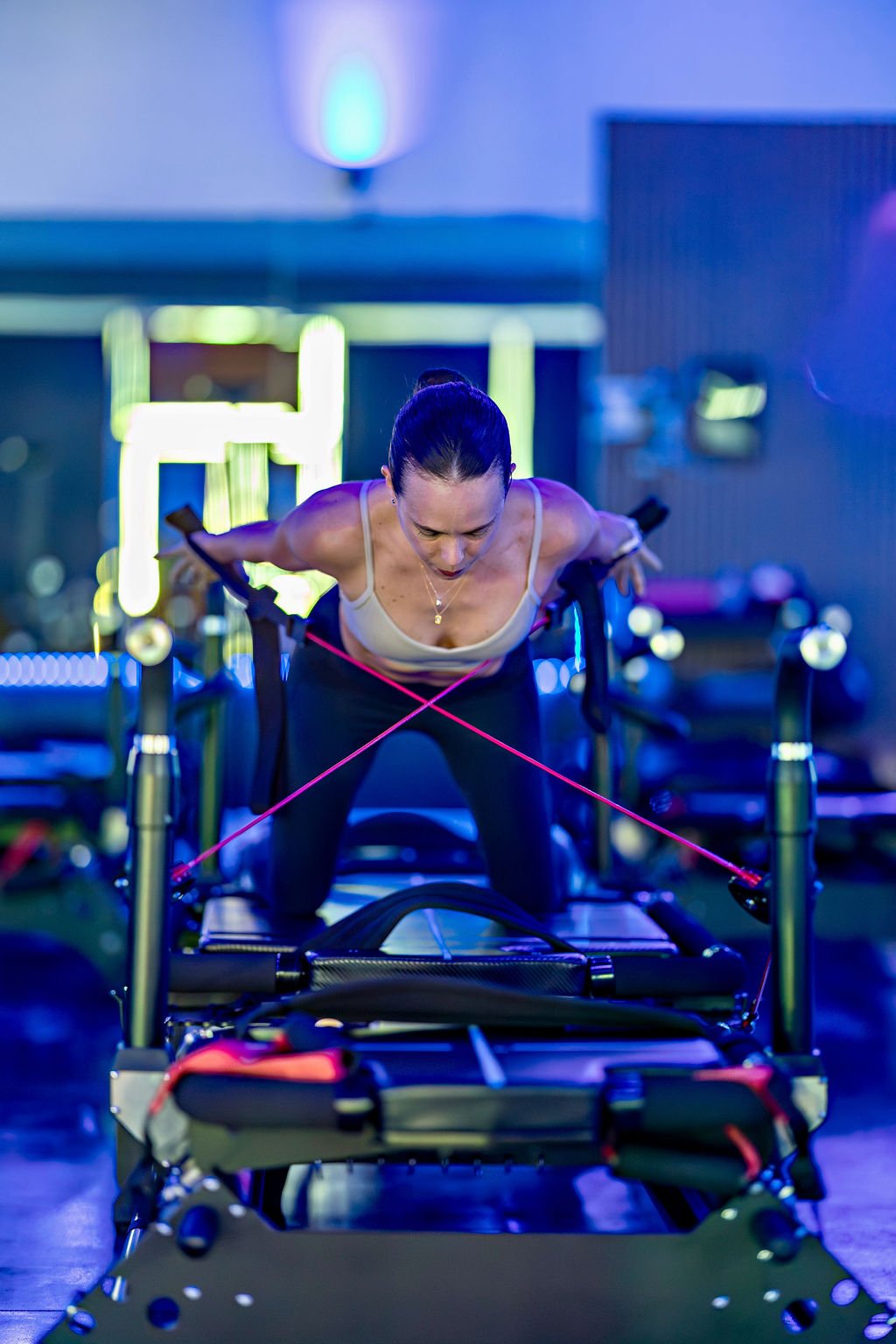
Yes. Reformer Pilates skips the pounding because the carriage and springs supply the resistance, so you load muscle without jumping or landing. At Persona Pilates, each 45-minute class works legs, trunk, and upper body with slow, controlled reps, and your instructor adjusts springs and range for your joints.
A lot of strength training treats your joints as landing gear. You drop, you plant, and you absorb force that had nowhere else to go. That can be a valid choice for some days. It isn’t the only way to get stronger, and it isn’t how Persona Pilates loads a body.
Class is 45 minutes of slow, controlled, full-body reformer work, and skipping the jumping and landing is the rule, not a side benefit. You’re still working. You’re just not pounding.
Personalized to you is how that stays honest. Your instructor reads your data before class, then watches how you actually load a knee, a hip, or a shoulder. Hands-on corrections keep the force in your muscles instead of in a joint that wasn’t asked.
How can strength travel through muscle instead of a landing?
On a Maven reformer, the carriage moves with you. It’s Persona Pilates’ custom reformer, from a partnership with Maven, and the springs, straps, and footbar are the resistance. You press, and you pull. You hold, and you return without a jump.
The demand is real because the springs don’t care whether you’re bouncing. If you rush, they yank you. If you go slowly, they make you own both directions. That’s time under tension, which is how lean muscle gets a reason to stay. (More on that in Is Slow Reformer Pilates Better for Building Strength?)
In your first class, you may notice your legs or trunk shaking during a hold. That’s common when you keep a position under spring tension. Stay steady if you can, and ask your instructor if you’re not sure whether to stay or back off.
Body composition is a long conversation with that kind of work. There’s no promised number of pounds or percent of change here. Coached, consistent, full-body sessions are how you ask your body to add useful muscle without beating up the joints you need for the rest of the week.
What does a full-body reformer class work in 45 minutes?
You’ll work legs, trunk, and upper body in the same session, and the reformer is built for that. Straps take the arms, and the footbar and carriage take the legs. The middle of you has to organize, or the rest of the machine doesn’t make sense.
Depending on the exercise, you’ll lie, sit, kneel, or stand on the carriage. One stretch of class might have you pressing through the footbar with your legs. Another might have you kneeling with the straps in your hands. Your trunk works through all of it, because it’s the part that keeps the carriage under control.
Slow work keeps your trunk in the conversation, so you can’t just throw a limb and hope the middle follows. Movement patterns are cleaner when you have time to notice where you dumped the load. Your instructor is there to notice it with you.
Modifications mean a cranky joint doesn’t have to cancel the whole class. Range can shrink, and springs can change. The session can stay full-body while one area gets a different version of the idea. That isn’t medical treatment. It’s coaching.
How does your Persona Survey aim the load?
The 3-minute Persona Survey (the Persona-lized Assessment) sorts you into one of five Personas: Vitality Voyager, Balance Builder, Zen Starter, Power Pursuer, or Recovery Resilient. Each has its own approach to pace, intensity, and focus. Under that, you get 1 of 125 unique fitness profiles (your Persona combined with your own attributes).
Your instructor reads that profile in proprietary software before you arrive. If your focus is how you load a hip, they’re not discovering that at minute 20. If your intensity needs to start lower, they already have a reason, and you can still update them at the reformer. The brief just means you’re not starting from a shrug.
In-house instructor training, not a franchise script, exists so those profiles turn into real coaching. A laminated sequence can’t see your knee. A trained person can.
That’s also why your first class is a good time to be specific. If a joint needs a smaller range, tell your instructor before you start. They can set up the exercise so the work stays in muscle from the first rep.
Is reformer Pilates without jumping a real workout?
People sometimes hear "no pounding" and translate it to "not serious." That translation misses the point. Controlling a carriage under spring tension is serious. So is holding a shape while the machine wants to close. Doing that for 45 minutes, full-body, with someone correcting your pattern, is work.
Grip socks are required because your feet are part of that control. No experience is needed because the instructor is there to teach you the machine. Your first class is $10, which is enough of a door to feel the difference between impact and load.
Progress on the reformer looks different from adding plates to a bar. Over time, your instructor may give you a longer hold, more range, a slower return, or a spring change. Each one raises the demand without adding impact. You get stronger by controlling more, not by landing harder.
Always tell your instructor about pain, because pain is information. If it lingers, check with your doctor or a physical therapist. This class isn’t a promise to erase a diagnosis. It’s a way to train strength with a coach who can change the setup.
If your goals shift, tell your instructor. The point is that the load stays aimed at the body you have now, not the body you described months ago.
How do you try it without guessing?
Take the Persona Survey so the load is aimed, then book a 45-minute class at Persona Pilates in Austin or Houston, such as Hill Country 71 or South Lamar. Wear fitted clothes, bring water, arrive a few minutes early, and put on grip socks.
Pick a class time you can repeat. Strength comes from coached work you keep coming back to. That’s why a studio on your regular route will do more for you than a perfect class across town.
Let the reformer move, and let your instructor put the work in muscle. Leave the landings for some other part of your week, or for none of it.
Book your $10 first class. Take the Persona Survey so your full-body session is coached to your joints and your goals, not to a generic template.