
A chatbot can draft a Pilates workout: a clear order of exercises, some variety, and a reminder to show up. In a recent reformer trial, though, a ChatGPT-adapted plan did no better than a fixed instructor-designed one. What a plan on a screen still cannot do is see your form, choose your springs, or change the work while you are in it.
What did the new reformer trial find?
In November 2026, researchers Bilge Gaye Yılmaz and Naci Kalkan published a randomized study in BMC Sports Science, Medicine and Rehabilitation (doi: 10.1186/s13102-026-02239-x). They compared two 8-week reformer programs in 30 healthy adults, ages 20 to 45, who already had Pilates experience.
Both groups trained twice a week for 60 minutes. Fifteen people followed a ChatGPT-adapted plan that was revised each week from their performance metrics. The other fifteen followed a fixed instructor-designed protocol of the same training volume.
Both groups improved in posture and movement over the eight weeks. The weekly AI updates did not produce a statistically significant advantage over the instructor-designed plan.
That finding is useful, but it has limits. The sample was small, and everyone in it was already experienced and healthy. The trial does not tell you what would happen for a beginner, or for someone coming back from pain or injury, and it should not be stretched past those 30 people.
Those sessions ran 60 minutes, longer than a 45-minute Persona Pilates class, and the trial was not run at our studios. It still shows what a ChatGPT-adapted plan could and could not add when training volume was equal.
It also did not test a coach changing your work in the moment. One group received a weekly chatbot plan. The other received a plan an instructor had designed and then kept the same. A written plan, even a good one, is not the same thing as someone watching you on the reformer.
What can an AI Pilates plan do well?
An AI Pilates workout tool can be a decent planner. If you ask a chatbot for a ChatGPT Pilates plan, it can suggest a sensible sequence, vary the work so you are not repeating the same few exercises, and remind you to get on the mat or the reformer.
That kind of structure is real help when you are practicing at home and you need a starting outline. It can also help you name exercises you already know, sketch a week of practice, and keep a home session from going stale. Variety keeps you from getting stuck in one groove. A reminder can be the difference between intending to move and actually moving.
None of that makes the plan personalized the way a class is. It makes it organized. Use it for that, and don't confuse a generated outline with coaching: a chatbot is a notebook with suggestions, not a coach beside you.
What can't an AI plan see in class?
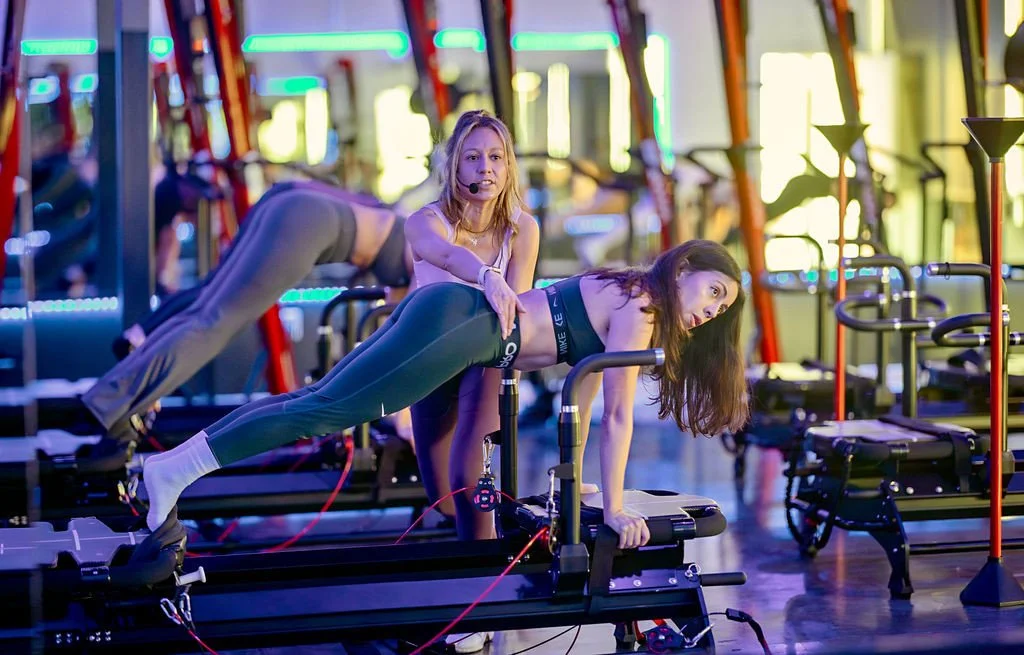
A chatbot cannot see your form. It cannot tell whether your ribs are flaring, your shoulder is creeping toward your ear, or you are dumping into the springs instead of controlling the carriage.
It cannot choose your springs. Spring choice is not a fixed setting you reuse for every exercise. It depends on the movement, the goal, and how you are moving in that minute.
It cannot catch pain flags. A sharp catch in a wrist, a pinch in a hip, or a neck that keeps gripping is information a coach uses on the spot. A plan written last night does not hear that.
It cannot see how you move today. You might have slept poorly, sat in the car, or felt strong in your legs and tight through your shoulders. An AI personalized Pilates prompt from earlier in the week does not know any of that unless you type it in, and even then the plan cannot watch what you actually do with the cue.
It also cannot hear your survey answers in the room, or adjust mid-class. If you are weighing an AI personal trainer vs instructor, that is the gap a weekly text plan cannot close.
How does a studio personalize your reformer class?
Persona Pilates starts before you get on the reformer. You take a 3-minute Persona Survey, also called the Persona-lized Assessment, that asks how you move, how you recover, and how you like to work.
The survey sorts you into one of five Personas, and that Persona combines with your own attributes to build 1 of 125 unique fitness profiles. Those five Personas (Vitality Voyager, Balance Builder, Zen Starter, Power Pursuer, or Recovery Resilient) set a starting approach to pace, intensity, and focus. The profile underneath is what your instructor actually reads.
Your instructor sees that profile before class, so your goals are not something you have to rebuild in the hallway. You can still say how you feel today. You should. The profile is a head start, not a substitute for being a person in the room.

Then the class itself is 45 minutes of full-body work on a Maven reformer, coached to you within a shared class structure. Your instructor can change a spring, shrink a range, or put a hand on your ribcage to cue breath. That is personalization you can feel in the minute you need it.
Should you use an AI plan and a class together?
You can use both, as long as you are clear about what each one is for.
Let a chatbot help with ideas at home: a short sequence, a reminder, a way to think about practice on a day you are not in the studio. Use class for coaching. That is where someone sees your form, hears what is going on today, and changes the work while you are doing it.
If you already have a ChatGPT Pilates plan you like, bring what you are curious about. Your instructor can tell you what translates to the reformer and what should stay off it. A chatbot will not stop you if a movement does not fit you. Your instructor will. The plan does not have to compete with the class. It just should not replace the person watching you.
How do you try it at Persona Pilates?
The clearest way to feel the difference is to take a class. Persona Pilates studios are in Austin and Houston, including South Lamar. Your first class is $10. No experience is needed. Grip socks are required; you can bring a pair or pick them up at the studio.
Start with the 3-minute survey so your instructor can read your profile before you arrive. Then book the class, show up a few minutes early, and get on a Maven reformer with a coach who already has your brief.
Book your $10 first class. Then take the Persona Survey.
Source: Yılmaz, B. G., and Kalkan, N. (2026). Reformer pilates improves posture and functional movement: a randomised comparison of AI-assisted and traditional personalisation. BMC Sports Science, Medicine and Rehabilitation. https://doi.org/10.1186/s13102-026-02239-x.